
AI Translations are currently in closed beta for the Growth and Premium plan. Please contact us with your store's myshopify domain if you would like to take part.
AI Translation is included for free starting with the Growth plan – with no character limits or additional fees. Stores with more than 10,000 products need the Premium plan for AI Translation; machine translation (NMT) remains available on Growth as before.
For general information about machine translation options in langify, check our guide Machine Translations.
Where to Find the New AI Translation Option?
Once the AI Translation feature has been enabled for your store, open the Machine Translation Settings and select AI translation as the translation method.
Langify then asks you to read and confirm a notice: it lists the caveats of AI translations and states that the texts to be translated are sent to Scaleway SAS (Paris, France) for processing.
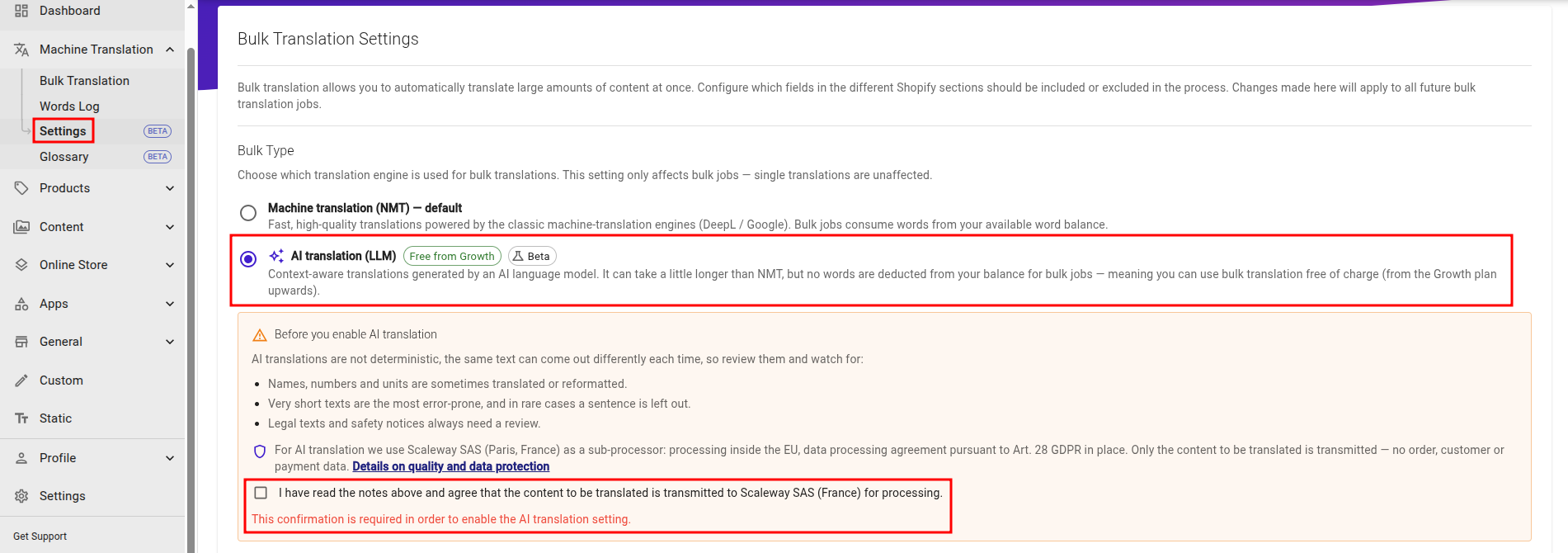
Check the "I have read the notes above and agree" and click on Save in the upper right corner. Afterwards, a Bulk Translation will use the new AI Translation option instead of the default Machine Translation (NMT).
Who processes the translations?
Translations are processed by Scaleway SAS (Paris, France) as the inference provider. Depending on the content, we currently use the open-weight AI models DeepSeek and Gemma—all of them run on Scaleway’s own infrastructure, not on the model developers’ servers. Processing therefore takes place entirely within the EU (see the Privacy section below for details).
Please note that we may adjust or replace the models used in the future as the AI landscape evolves and/or depending on availability and performance, while maintaining the same processing setup (EU-based inference on Scaleway infrastructure).
Advantages
- Free from Growth plan onwards: No additional translation costs, no matter how much content you translate.
- High quality: In our own benchmark tests, AI translations performed on par with DeepL. For regular store content and product descriptions, little or no post-editing is usually needed.
- Natural language flow: The AI tends to transfer context and idioms more freely and naturally than classic machine translation.
- Very broad language selection: Significantly more target languages are available than with DeepL.
- GDPR-compliant EU processing: Processing takes place exclusively at Scaleway in France, with no transfer to third countries.
- Automatic protection of HTML and Liquid: langify automatically protects Liquid variables (e.g.
{{ product.title }}) and HTML tags so your theme layout stays intact.
Disadvantages and typical weaknesses
So you know what to look out for when reviewing – these are the issues we encountered most frequently in our own tests:
- The AI invents more: It occasionally adds details that aren't in the source text – embellished product claims, invented feature names, or extra filler sentences. Classic machine translation stays closer to the original, so marketing copy in particular is worth a read-through.
- Numbers, sizes, and units of measurement: Values are occasionally converted or reformatted. It's worth double-checking product specifications.
- Form of address and tone: Formal vs. informal address (e.g. "tu" vs. "vous", "du" vs. "Sie") may vary between individual texts.
- Missing text parts: In rare cases, a sentence may be omitted. This is easy to miss because the text still reads fluently. For long descriptions, check for completeness.
- Quality varies by language: English, French, Spanish, and Italian were particularly reliable in our tests; for languages such as Arabic and Japanese, manual corrections are more often needed.
Also good to know: Two runs over the same text can produce different results.
Privacy
For AI translation, we use Scaleway SAS (Paris, France) as a sub-processor. Processing takes place within the EU, and a data processing agreement pursuant to Art. 28 GDPR is in place. Only the content you choose to translate is transmitted – no order, customer, or payment data from your store. Scaleway is included in our list of sub-processors.
Alternative: DeepL Translation
Alternatively, you can continue to use DeepL Translation for bulk translations. DeepL works segment by segment and therefore delivers particularly consistent results: omissions are practically impossible, glossary terms are enforced more strictly, and the same source material reproducibly yields the same translation. On the other hand, translations are more literal and the language selection is smaller. Depending on your plan or usage, additional costs may apply.
Which option should I choose?
AI Translation is the right choice for the majority of your content: product descriptions, pages, blog posts, category texts. DeepL is worthwhile where reproducibility and strict terminology enforcement matter more than cost – for example, with very large, well-maintained catalogs that rely on a fixed vocabulary.
Regardless of the method you choose: automatic translations cannot fully replace a human review.